“The Lord is my strength and my shield; my heart trusts in Him, and He helps me.”
— Psalm 28:7 (NIV)
Opening Thought
True strength isn’t about muscle or might — it’s about dependence.
Real power comes not from the body, but from the heart that fully trusts in God.
The life of David shows us that strength begins in surrender.
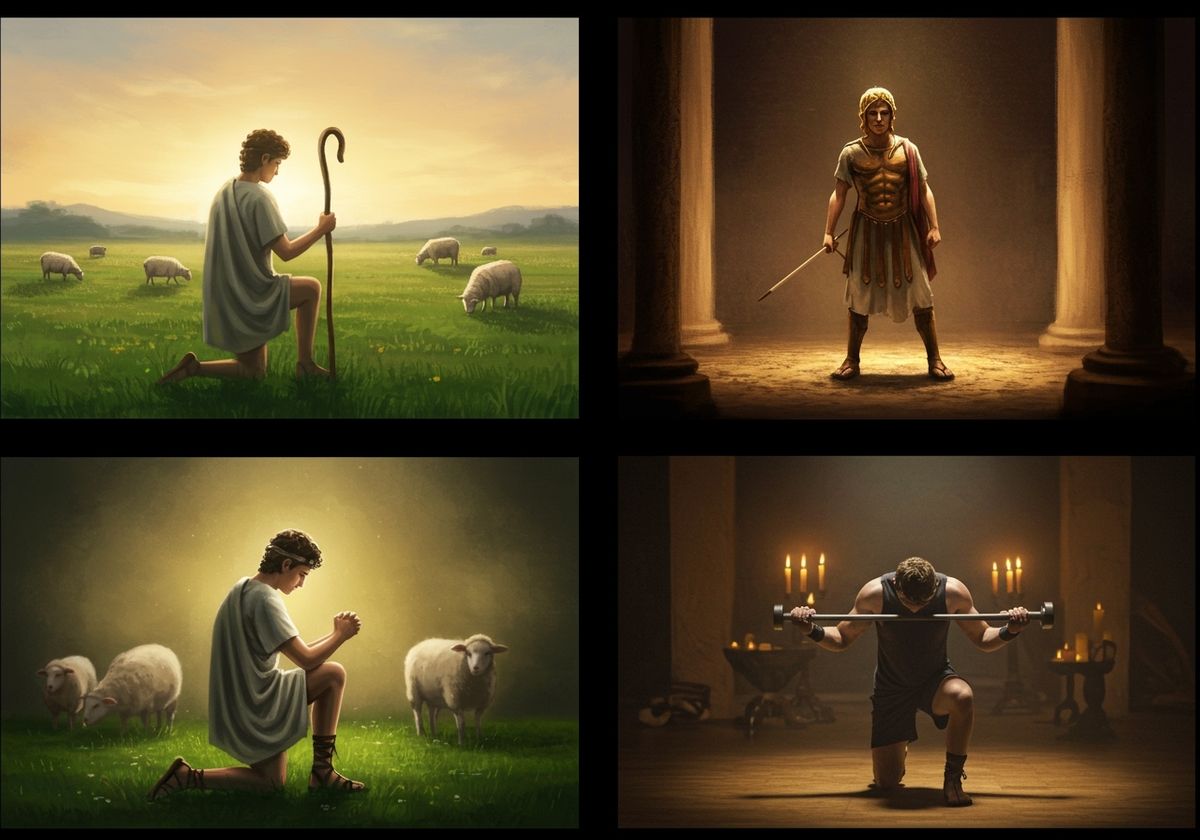
He was a shepherd before he was a soldier, a servant before he was a king. David’s victories — from the pasture to the battlefield to the throne — all flowed from his faith in God’s power, not his own ability.
When David stood before Goliath, he didn’t rely on armor, muscle, or experience. He relied on the Lord.
That’s strength: to face giants knowing that your confidence comes from something greater than you.
Just as David’s battles trained him for purpose, your struggles — physical or spiritual — are the resistance God uses to build His strength in you.
Biblical Reflection: David’s Path to Strength
Strength in the Pasture (Preparation)
Before David ever fought Goliath, he trained in obscurity — killing lions and bears while protecting his sheep (1 Samuel 17:34–36).
God builds strength in secret long before He reveals it in public.
👉 The unseen seasons are the proving grounds for powerful faith.Strength in the Battle (Courage)
When the world saw a boy with a sling, David saw a victory already secured by faith.
He declared, “The Lord who rescued me from the paw of the lion and the bear will rescue me from the hand of this Philistine.” (1 Samuel 17:37)
👉 True strength doesn’t deny fear — it faces it with faith.Strength in the Cave (Endurance)
After victory came waiting. David hid in caves, hunted by Saul (1 Samuel 22).
God used isolation to deepen David’s dependence, teaching him that strength is not sustained by success but by surrender.
👉 Strength is not just found in the fight, but in faithfulness during the waiting.Strength in the Throne (Stewardship)
Once David became king, his greatest challenge wasn’t his enemies — it was himself. His failure with Bathsheba showed that unchecked pride and comfort can corrupt even the strongest. Yet his repentance restored him. (Psalm 51)
👉 Real strength is not perfection; it’s the humility to repent and rise again.
Faith & Fitness Connection
Strength is built under resistance — whether that’s a weight, a hardship, or a season of waiting.
In fitness, resistance creates micro-tears that allow muscles to rebuild stronger.
In faith, trials break self-reliance so that God’s power can rebuild your spirit.
David didn’t find strength through ease; he found it through effort, endurance, and obedience.
You don’t become strong by avoiding struggle — you become strong by trusting God through it.
Lessons from David’s Strength
Strength grows in the unseen. Private faithfulness leads to public power.
Strength stands when others flee. Face your giants — physical, emotional, or spiritual — with confidence in God, not yourself.
Strength surrenders pride. Repentance and humility keep strength holy.
Strength serves. David used his position to bless others; strength is meant to lift, not dominate.
Discussion Questions
What “giants” in your life are you trying to fight in your own strength instead of God’s?
How can you honor God with both physical and spiritual strength this week?
What unseen “pasture season” might God be using to prepare you for your next victory?
What does it look like to stay humble and surrendered once God elevates you?
Takeaway Truth
Strength is not about control — it’s about confidence in the One who holds control.
Like David, your greatest victories come when you stop striving in your own power and start standing in God’s.
Every battle, every burden, every workout can be a place where God builds His power in you.
Challenge for the Week
Faith Challenge: Identify one area where you’ve been trying to carry the weight alone. Pray and release it to God this week.
Fitness Challenge: Add one “David Rep” to every exercise — one extra repetition dedicated to gratitude for God’s strength in your weakness.
Each day declare:
“The Lord is my strength, my shield, and my source.”